Service
Portable generator hookups
When the power goes out, a generator inlet and interlock let you run your home’s essential circuits from a portable generator. No extension cords through a window, and no back-feeding the grid.
- 5.0 on Google
- Licensed, Bonded & Insured
- WA Lic. WESTPEL745M7
A hookup makes sense if
- You already own a portable generator, or plan to buy one.
- Outages leave you without heat, a refrigerator, or a well pump.
- You’ve been running extension cords through the house.
- You want backup power without the cost of a standby system.
What we install
The setup is simple, and it’s the code-compliant way to connect a portable generator to a house.
- A weatherproof inlet box on the outside of the house
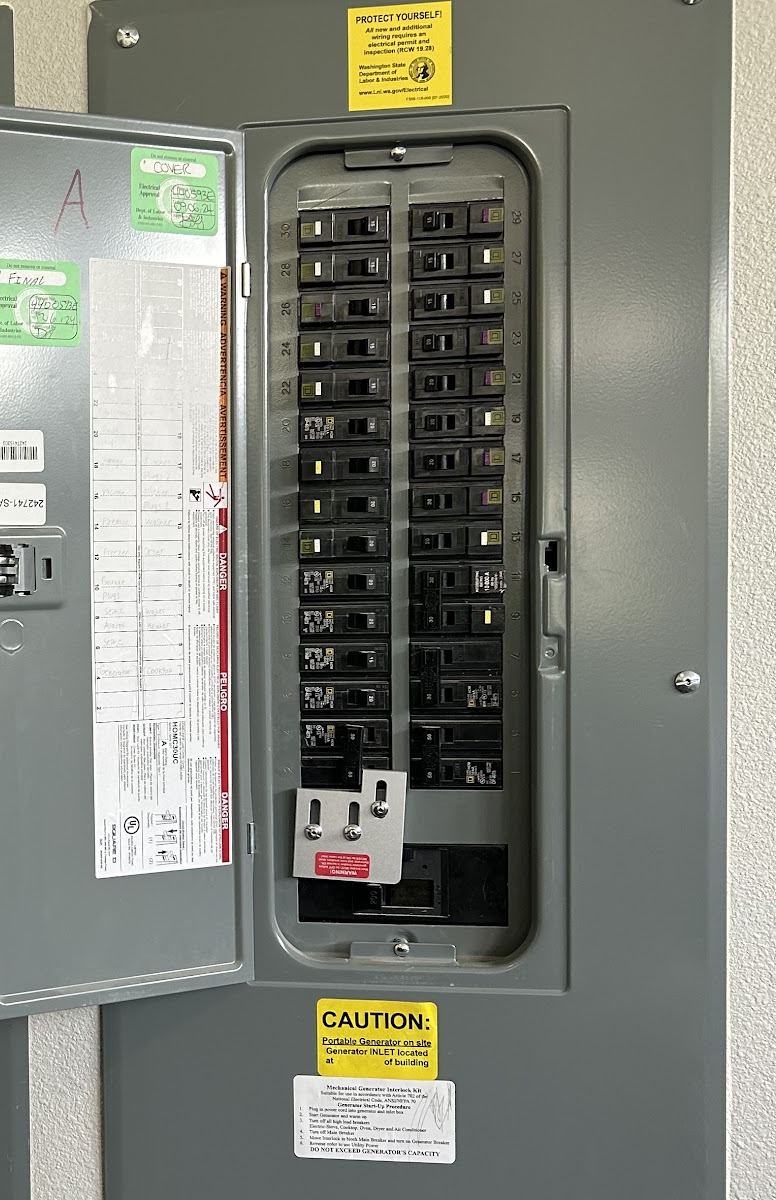
- An interlock at the panel, so the generator and the utility can never be connected at the same time
- A breaker and wiring sized for your generator
- Clear labels at the panel
- Permit and inspection
How it works during an outage
Roll the generator outside and plug its cord into the inlet. At the panel, switch off the main breaker, slide the interlock, and switch on the generator breaker. Then turn on the circuits you need. When utility power returns, reverse the steps.
Interlock, transfer switch, or standby generator?
There are three ways to power a house from a generator. This page is about the first two, which use a portable generator.
- Interlock kit: a mechanical plate on your existing panel. With an inlet, it lets a portable generator feed any circuit in the panel, within the generator’s capacity.
- Manual transfer switch: a separate small panel with a chosen set of circuits moved onto it. It suits a panel that has no listed interlock kit.
- Standby generator: a permanently installed unit with an automatic transfer switch. It starts by itself and costs many times more.
Sizing and safe use
Most portable generators have a 30-amp or 50-amp 240-volt outlet, and the inlet, cord, and breaker are matched to it. A 30-amp inlet carries up to about 7,200 watts. A 50-amp inlet carries up to about 12,000.
Run the generator outdoors, well away from doors, windows, and vents, because the exhaust carries carbon monoxide. Clark Public Utilities also warns never to plug a generator into a wall outlet, since it can back-feed the grid and put line crews in danger.
Process
How the job goes
Match it to your generator
We check the generator’s output and your panel, and decide where the inlet should go.
Estimate and permit
You get a price for a defined scope. We pull the permit.
Install
Inlet, wiring, breaker, and interlock go in, and everything is labeled.
Inspection and walk-through
After inspection, we show you the changeover step by step.
What affects the cost of a generator hookup
An inlet and interlock is one of the smaller permitted jobs we do. These are the things that change the price.
- The distance between the inlet location and the panel
- Whether a listed interlock kit exists for your panel, or a transfer switch is needed
- A 30-amp or a 50-amp setup
- The panel’s condition. An interlock can’t go on a panel that needs replacing.
Do we cover your address?
Our service area page lists every community we work in.
From a customer
I called WestPeak and Ed was able to come and set up a generator plug for me so I can use my generator as a back up. I was happy with how fast he responded and came and did a quality job.
Questions
Things people ask us.
Does WestPeak Electric do portable generator hookups?
Yes. WestPeak Electric is a licensed electrical contractor (Washington license WESTPEL745M7). We do portable generator hookups throughout our service area. Call or text 360-521-6913, Monday to Friday, 7 AM to 5 PM.
Can’t I just plug the generator into a wall outlet?
No. Back-feeding through an outlet energizes the utility lines outside your house, which can kill a line worker, and it bypasses your home’s safety devices. It is also a code violation. An inlet with an interlock makes it physically impossible for the generator and the utility to be connected at the same time.
What can I run on a portable generator?
That depends on the generator. A typical portable unit can cover a refrigerator, a furnace blower, lights, and some outlets, though not everything at once. We’ll help you work out which circuits fit.
Do I need a permit for a generator inlet?
Yes. An inlet and interlock is new wiring at your panel, so it needs an electrical permit and an inspection. We handle both.
What is the difference between an interlock kit and a transfer switch?
An interlock is a mechanical plate on your existing panel that keeps the main breaker and the generator breaker from being on together. It lets the generator feed any circuit in the panel, within its capacity. A manual transfer switch is a separate small panel with a chosen set of circuits moved onto it. An interlock usually costs less, when a listed kit exists for your panel.
What size generator do I need to run my house?
Add up what has to run at the same time. A 5,000 to 7,500-watt portable covers the basics in many homes: a refrigerator, a furnace blower, lights, and some outlets. Central electric heat, an electric range, and an electric water heater are more than a portable generator handles well.
Does Clark Public Utilities allow a portable generator hookup?
Yes, as long as the hookup can’t back-feed the grid. The utility’s guidance is never to plug a generator into a wall outlet, and to have a professionally installed cut-off switch before running one through the panel. An interlock or a transfer switch is that device.
Request an estimate
Have an electrical project coming up?
Tell us what’s going on. We’ll ask the right questions, look at the job if it needs it, and give you a clear scope and price.
- 5.0 on Google
- Licensed, Bonded & Insured
- WA Lic. WESTPEL745M7